The World's Fastest-Growing Care Business Is Landing in Havana
AH
As the planet ages faster than it can build the infrastructure to care for it, a quiet industry is turning into one of the biggest growth stories in global services. Cuba, the most aged nation in Latin America, is now opening its doors to private caregiving — and one Havana-based agency, Abuiya, offers a case study in what it takes to build trust, and a business, around the most personal decision a family can make.
A Trillion-Dollar Shift in How the World Grows Old
Elder care used to be treated as a domestic matter, something families handled quietly and institutions handled reluctantly. That framing no longer fits the numbers. By mid-2024, the global population aged 65 and older had already passed 700 million people; by 2050, that figure is expected to more than double to roughly 1.5 billion, meaning one in six people on the planet will be a senior (Elderly Care Market Report 2026). Multiple industry analysts now size the global elder-care market in the hundreds of billions of dollars annually (Elderly Care Market Size, Share & Industry Analysis), with several forecasts placing it well past the trillion-dollar mark by the end of this decade, expanding at a high single-digit compound annual growth rate (Coherent Market Insights).
What's driving that growth isn't only the number of older adults — it's a structural shift in who is expected to look after them. Smaller families, longer working hours, cross-border migration, and rising chronic disease are quietly dismantling the assumption that care will simply happen at home, provided for free by a daughter, a son, or a neighbor. Home-based and live-in care are consistently identified as the fastest-growing segments of the market, precisely because families want their elders to stay in familiar surroundings, cared for by trained professionals, rather than moved into institutions. In other words: the world doesn't just need more elder care. It needs elder care that can be trusted, personalized, and coordinated — often from far away.
Few places illustrate that need more starkly than Cuba.
Cuba: The Oldest Country in Latin America
Cuba now carries a demographic distinction no country wants: it is the most aged nation in Latin America and the Caribbean. Official figures put the share of Cubans aged 60 and older at roughly 26–27% of the population, the highest proportion in the region, and the trend is accelerating rather than leveling off. In Havana province specifically, more than a quarter — closer to 28% — of residents are seniors, among the highest concentrations anywhere on the island.
The causes compound each other. Cuba has recorded more deaths than births every year since 2019. At the same time, the island has lost more than a million and a half people to emigration in just the last five years, disproportionately young adults and working-age citizens who leave to seek opportunity abroad. The result is a shrinking population with an ever-larger share of elders and an ever-smaller share of the working-age children and grandchildren who, culturally, have always been expected to care for them.
The traditional model of family-based elder care in Cuba isn't weakening. It's collapsing under demographic pressure the culture was never built to withstand.
Cuba's public health system remains universal on paper, but it was never designed to deliver the kind of daily, personalized, long-term support that a rapidly aging population now requires — bathing, medication management, mobility assistance, cognitive stimulation, emergency response. That gap between what the state can offer and what families actually need is precisely where a private caregiving market has begun to emerge.
And critically, in a huge share of these households, the person making the decision — and paying for it — isn't even on the island. Cuba's diaspora in the United States, Spain, and elsewhere has become the de facto buyer for elder care back home: adult children with real purchasing power, real guilt about the distance, and a real need for reassurance that someone they trust is looking after their parents when they cannot.
An Opening for Private Care
For decades, elder care in Cuba was the exclusive domain of the state, delivered through government-run "casas de abuelos" and nursing homes. That began to change in 2021, when Cuba authorized the creation of private small and medium enterprises for the first time in six decades.
The opening has continued to widen. In early 2026, the Cuban government formally authorized private businesses, cooperatives, and self-employed workers to operate day-care and residential elder-care homes for the first time, citing the accelerated aging of the population and the state's own admitted inability to meet demand. And as of a decree published in late July 2026, taking effect in August, Havana further reduced the list of activities off-limits to the private sector, formally including caregiving and rehabilitation services alongside pharmacies and other previously state-only functions.
None of this amounts to privatization in the traditional sense — the state continues to operate its own homes and requires private operators to reserve a share of capacity, use trained caregivers, and maintain ties to the public health network. But for entrepreneurs, it is a clear, if cautious, signal: private eldercare is no longer a legal gray area in Cuba. It is a sanctioned, structured, and growing category — one with high demand, thin structured supply, and almost no professional branding to speak of. That combination is precisely what makes a market attractive to build in early.
Abuiya: Care Built as a Business, Not Just a Service
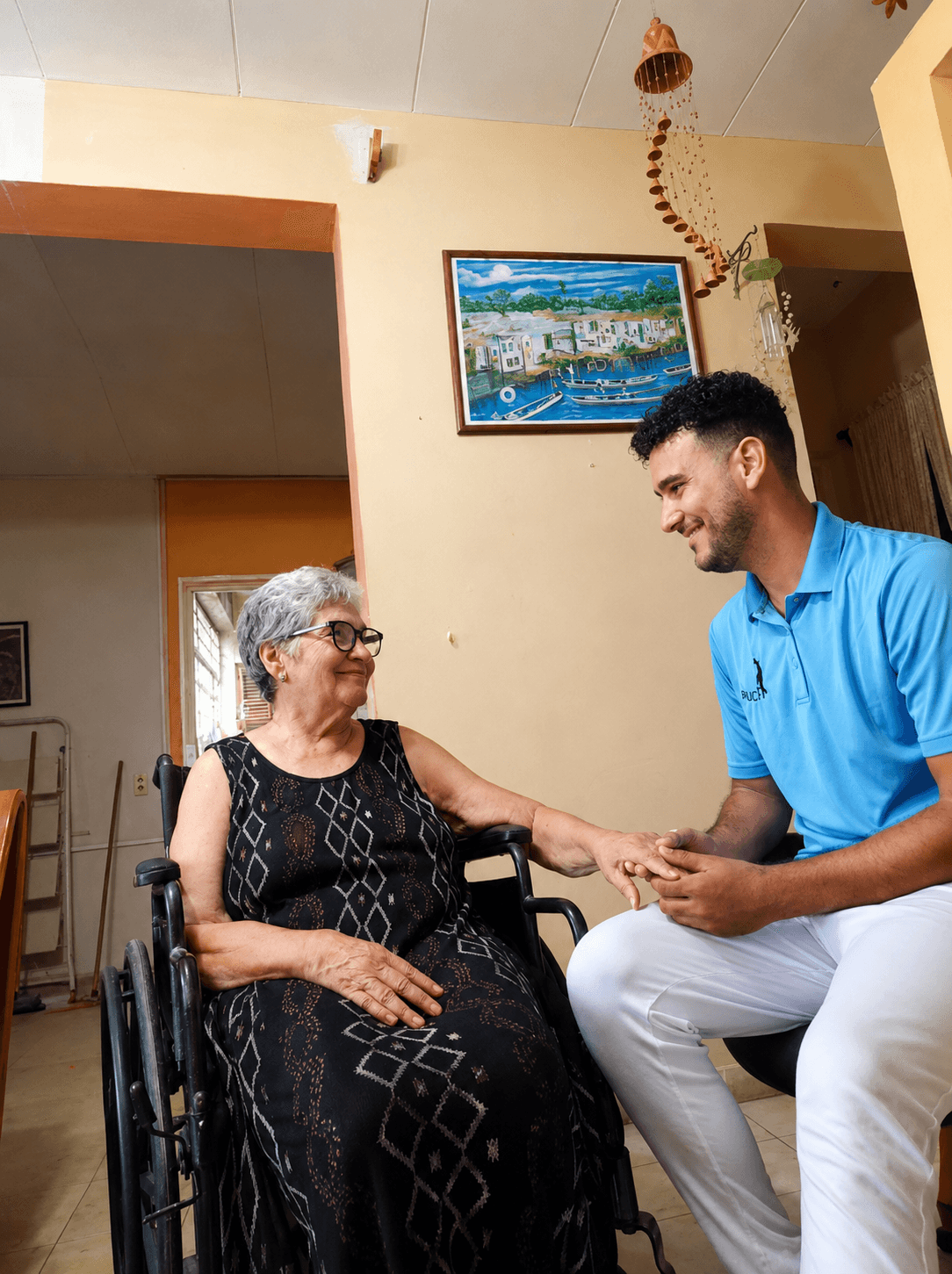
Based in Havana, Abuiya was built directly into that gap. Rather than positioning itself as a source of companionship alone, the agency delivers home- and hospital-based care led by qualified health professionals — including physicians with intensive-care experience — who take direct, personalized responsibility for each patient's evolution, not just their supervision. Families choose from flexible windows of coverage (8, 12, or 24 hours daily), and the agency's scope extends from everyday support, such as hygiene, nutrition, and medication management, to physical and cognitive rehabilitation, palliative care for high-complexity cases, and defined emergency-response protocols.
What distinguishes Abuiya commercially is less about what it does than who it is built to convince. Its buyer persona isn't the elderly patient in Havana — it's the son or daughter abroad who has already tried and lost confidence in informal, individual caregivers, who has money to invest but has been burned before, and who needs proof, not promises, that this time will be different. Everything about the agency's positioning follows from that insight: transparent reporting back to the family, visible evolution and "before and after" outcomes, and a brand voice that treats the relationship as emotional first and transactional second.
That shows up clearly in the brand's own language. Abuiya doesn't market itself with the vocabulary of institutional healthcare — "patient," "protocol," "case." It leads instead with warmth: cariño, acompañamiento, confianza. Its slogan doesn't sell a service; it sells a promise to a family split by geography — that even from a distance, they can still be the ones showing up for their parents.
The Marketing Lesson: Trust Is the Product
For any business selling to a buyer who cannot physically inspect the service — which is precisely the position of a diaspora client hiring a caregiver 90 miles or an ocean away — trust isn't a nice-to-have layer on top of the offer. It is the offer. That reality reshapes what good marketing looks like in this category. Direct-sales messaging ("book now," "buy this package") tends to underperform, because it asks for commitment before the audience has any reason to believe the promise will hold.
The more effective approach, and the one built into Abuiya's content strategy, treats trust-building as a distinct, earlier stage of the funnel: shareable, emotionally resonant content — nostalgia for a grandparent's sayings, humor that only a Cuban family would recognize, real testimonials from patients and relatives — designed to be saved and shared rather than merely liked. Calls to action are framed around helping someone else in the same situation, not around converting the viewer directly. Conversion is treated as the outcome of trust already built, not a separate campaign layered on top of it.
It's a pattern worth noting for any operator entering elder care, in Cuba or elsewhere: the product being sold is peace of mind for someone who isn't in the room, and every piece of marketing should be built to earn that, not assume it.
What Cuba Signals for the Rest of the Region
Cuba's demographic trajectory — rapid aging, a shrinking workforce, and a strained public system — is not unique to the island. It is a preview. Latin America as a whole is aging faster than any region in history relative to its stage of economic development, and the same forces now reshaping Havana's care market will reach the rest of the region within a generation.
What's happening in Cuba right now — a regulated but genuine opening of private eldercare, entrepreneurs building for a remote, emotionally invested buyer, and brands winning not on price but on trust — is a small, distilled version of a much larger global story. Elder care is no longer a cottage industry. It's becoming one of the defining service businesses of the next thirty years, and the operators who understand both the caregiving and the psychology of the family paying for it, the way Abuiya has, will be the ones who define what the category looks like next.